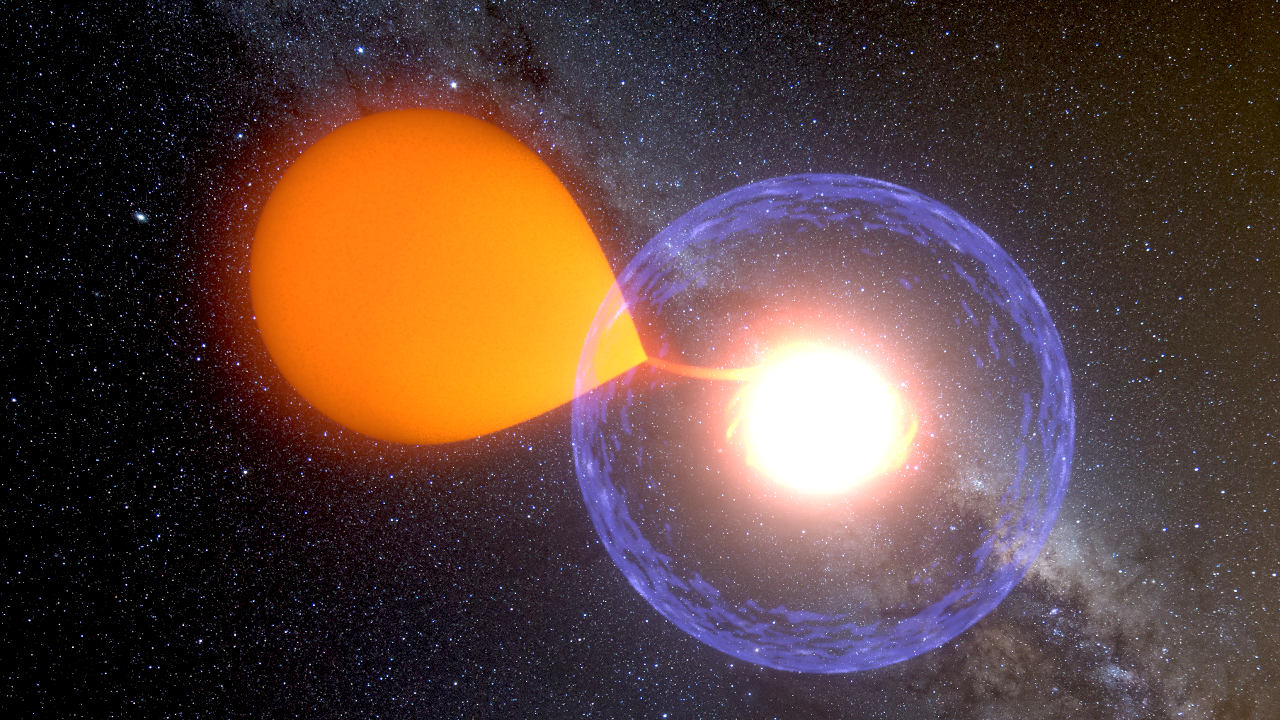
Classical novae are nuclear flashes on the surface of the extraordinarily dense, burnt-out husks of old stars, known as white dwarfs. The white dwarfs must have a binary companion–I.e., paired with another star–that the white dwarf can use to steal hydrogen. This pilfered gas piles up on top of the white dwarf, and when enough piles up, the hydrogen ignites in a thermonuclear explosion.
I studied the unexpected discovery of gamma-ray emission in classical novae. The detection of these extremely energetic gamma rays meant that we had to revisit our model for classical novae, forcing us to include shocks–that is, two pieces of ejected material that smash into one another.
For my Ph.D., I used multi-wavelength analysis–including gamma rays, x-rays, optical, IR, and radio emission–to model V1324 Sco, the most gamma-ray luminous nova (at the time). We showed that, except for the gamma-ray emission, V1324 Sco would be considered a “typical” classical nova, disproving the idea that gamma-ray novae should be classified separately. Based on this work and work I conducted with Brian Metzger and Kwan-Lok Li, we concluded that gamma rays could be emitted in all classical novae with varying intensity.
My Ph.D. adviser was Professor Laura Chomiuk.
 Dr. Tom Finzell